A CLEAR WAY INTO A COMPLICATED IDEA
Pearl’s money.
A finite supply. A gradual release. Follow the whitepaper’s monetary schedule, from the first reward to the long tail.
The INT whitepaper specifies 2.1 billion PRL, a 194-second target block interval and a smoothly decreasing block subsidy. Its supply schedule runs by block height—not by a promise that a particular amount will be issued on a calendar date.
The supply is finite.
The release takes time.
The whitepaper sets the supply parameter at 2,100,000,000 PRL. It calls the smallest supported unit, one hundred-millionth of a PRL, a grain. The supply parameter is not the amount already circulating.
The founders’ no-pre-mine statement describes how coins are initially issued. It does not mean founders or investors cannot mine, buy or subsequently hold PRL. Nor does it establish how broadly ownership is distributed.
The supply curve and the distribution of holdings answer different questions: one concerns issuance; the other concerns who owns the coins.
INT whitepaper, section 5.4 ↗ · Hear the no-pre-mine statement ↗
A target interval.
Not a stopwatch.
The specified interval is 194 seconds, or 3 minutes 14 seconds. Actual time between blocks varies. Difficulty adjustment aims to keep the average near the target as mining conditions change.
That interval is not a guarantee that a payment is irreversible after 194 seconds. Inclusion, additional confirmations and the possibility of a chain reorganization are separate considerations.
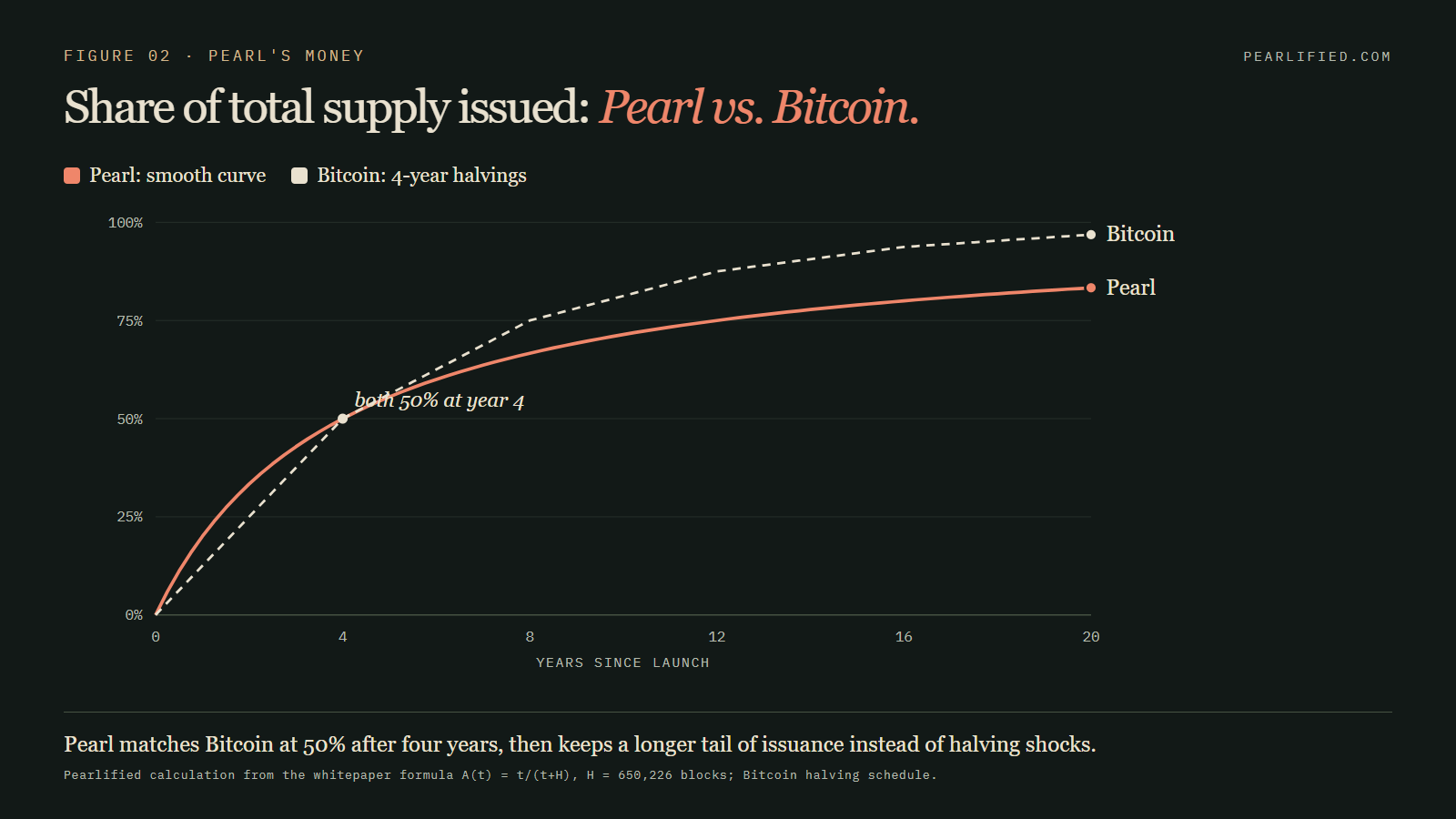
For issuance charts, it also means that “year four” is shorthand: the whitepaper’s characteristic height is 650,226 blocks, roughly four 365-day years at the target interval. Real calendar time depends on the blocks actually produced.
Move through
the long tail.
Instead of periodic halvings, the stated subsidy declines each block. The ideal cumulative curve reaches half of the supply at height 650,226; another equal interval brings it to two thirds, not three quarters.
Illustration at height 650,226. Grain rounding applies to each block reward.
| Target-time equivalent | Issued fraction | Unissued fraction |
|---|---|---|
| About 4 years (H) | 50.00% | 50.00% |
| About 8 years (2H) | 66.67% | 33.33% |
| About 20 years (5H) | 83.33% | 16.67% |
A longer issuance tail continues to fund block subsidies. Whether that produces a desirable security budget depends on reward value, mining costs and participation; the schedule alone cannot establish it.
The curve,
without the hand-waving.
Let S = 2,100,000,000 PRL, H = 650,226 blocks, and t be the number of blocks since genesis. The whitepaper’s ideal cumulative allocation is:
Issued PRL = S × t / (t + H)
The discrete subsidy for block t, starting at t = 1, follows from the difference between consecutive cumulative values:
E*(t) = S × H / [(t + H)(t + H − 1)]
The actual specified subsidy is rounded down to whole grains at each block. The explorer uses that discrete formula for the subsidy, and the ideal cumulative formula for the total; it does not sum all rounded historical block rewards.
Why the chart is not a circulating-supply feed
It uses the published schedule and a hypothetical block height. It does not query the chain, account for lost coins, identify liquid holdings or verify current consensus code. Calendar years are converted using 365-day years and the 194-second target.
Check the equations in section 5.4 ↗. Verified against page 24 of the supplied INT whitepaper printout.
An issuance rule
is not a price model.
A limited supply describes the issuance rule. It does not create demand, guarantee returns or tell us what PRL should trade for. A smoothly declining subsidy also does not remove changes in mining competition or operating costs.
The more interesting project question is how the token connects to a service. The founders describe an ambition to turn PRL back into compute; whether a payment market is available, and how it settles, needs separate evidence.
THE FOOTNOTES ARE PART OF THE STORY
Open the source file.
- Pearl INT whitepaper, section 5.4 ↗
Supply, denomination, target block interval, H and the discrete emission formula. Supplied printout pages 23–24; online text checked 28 September 2026.
- The founders on allocation and pre-mine ↗
A contextual source recording; not an independent ownership-distribution audit.
- The proposed compute-payment loop ↗
The stated ambition is distinct from verified product availability.
Words and illustrations by Pearlified. Send a correction or source.