Who was in the room?
EXHIBIT C · SEALED SUMMITThis one wasn't a livestream — it was an invite-only Pearl summit. And on stage, the CEO kept accidentally describing his own audience. Quotes are verbatim from the keynote; our read is in red.
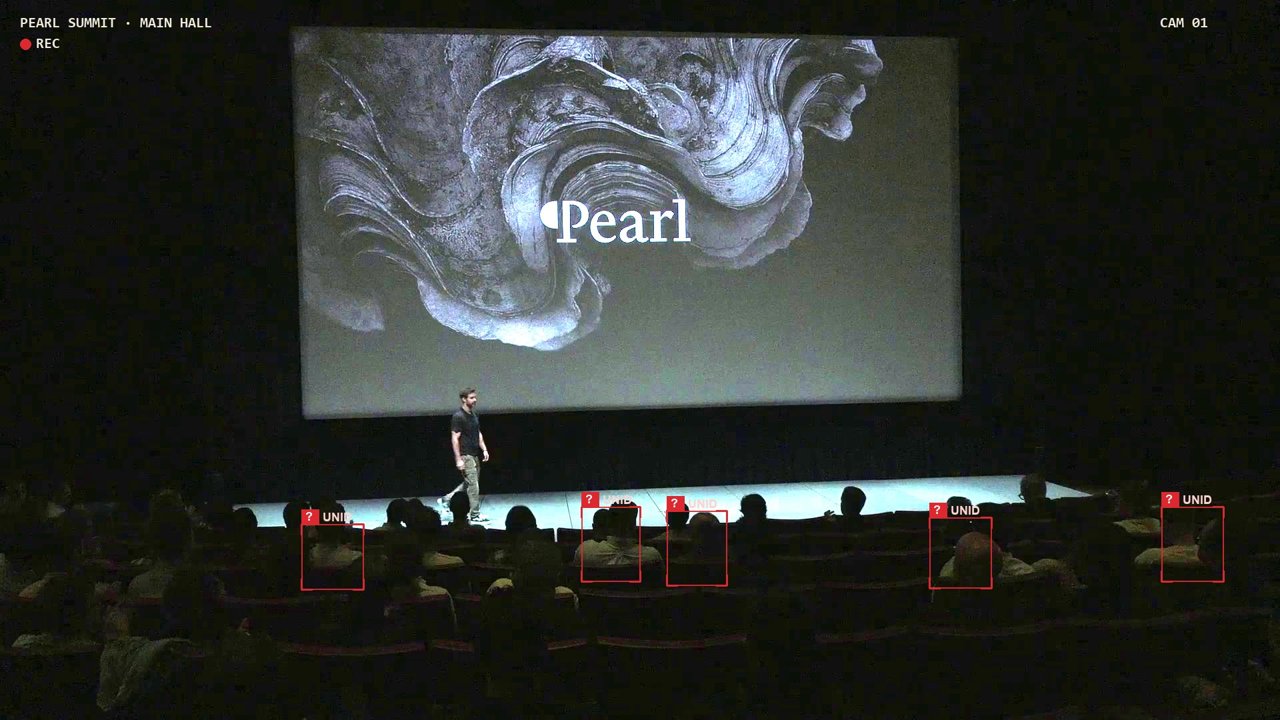
Some of the frontier labs in this audience are spending 100 million, 130 million dollars a day on inference — if I'm correct.
→ Almost nobody on earth spends $100–130M a day on inference. That club is roughly OpenAI, Google, Anthropic, Meta, xAI — and at least one of them was sitting in the seats.
We don't get an Anthropic or NVIDIA share — well, most of us at least.
→ "Most of us" isn't "all of us." He caught himself: some people in that room have a direct financial tie to Anthropic or NVIDIA — closer than ordinary professional overlap.
This assumption here, which has been tested by a lot of world-class mathematicians — some of which are in this crowd.
→ He wasn't bluffing. A GPU's matrix-multiply isn't bit-reproducible, so how do you prove a miner did real work? A paper published this year — Hawkeye: Reproducing GPU-Level Non-Determinism, the entire foundation of proof-of-useful-work — solves exactly that, and got both a Research-Track oral (MLSys's selective distinction) and a poster at MLSys 2026. The author list: Stanford's Dan Boneh, head of the Applied Cryptography Group and one of the most cited cryptographers alive; co-founder Ilan Komargodski; Stanford's Megha Srivastava; and a member of Pearl's own engineering bench.
The tell: the paper never once says "Pearl," "blockchain," or "cryptocurrency" — clean, neutral academic ML research, fully decoupled from the crypto product it quietly underpins.
“The existing system supports int computations, so we do need to quantize models to int right now… But we have a next generation scheme… ready in a couple of months supporting floating point computations. And then you won't need to do any quantization whatsoever.”
— Ilan Komargodski, co-founder (public clip)
Here's the part they don't spell out: the reason it's int-only today is that to verify a miner actually did the work, the math has to be bit-for-bit reproducible — and floating-point GPU computation famously isn't. That is precisely the problem Hawkeye: Reproducing GPU-Level Non-Determinism solves. So the "next generation floating-point scheme, a couple of months away" and the Boneh-co-authored paper aren't two things — they're the same thing. The academic keystone is the product roadmap. Boneh's signature is on the release notes.